Exponential x Existential = The Problem
Most of us don't have a sense of why we're here; that's stopping us from dealing with crisis.

Many years ago, whilst we were working in Extinction Rebellion, my friend Roger made an argument that the climate crisis was, by its very nature, a specific type of problem.
He noted that if we failed to recognise the hard work needed to conduct the proper analysis the climate crisis required, we would not be able to think well enough about what we might do (about it, or anything else).
Roger said that, unlike other justice issues or injustice issues, or even intersecting issues of ethics, morality and virtue, the characteristics here were uniquely specific — and mostly ignored. This was because the situation is at once exponential and existential. Which, if you take a moment to think about it, is probably just about one of the worst combination of properties that any problem can have.
At the time this was mostly ignored by the liberal intellectual space, political progressives, journalists and swathes of academia. Now, though, we have super brainy people on the internet talking about metacrisis, meaning crisis, polycrisis, and a preferred term of mine (via our pal Charlie) the multifaceted intersecting shit show.
Sure, there is now way more acknowledgment of the level of totally severe fuckedness. But there’s still no sense in anyone’s actions or sentiment that we are on a time axis with exponentiality at play. Worse still, nonlinearity will shock this exponential function, making a pattern we can’t comprehend into a pattern we can’t see any patterning in. What can we expect then: a self-perpetuating spiral into non-sense? Is sense the specific thing we should try to rediscover, nurture, revere?
I’m not sure, so I thought I’d try, once again, to pull it apart and share my thoughts on it, in case it helps others to reframe the context of their own work and lives. As Indy Johar writes on his substack, I’m writing to think, not to convince.
A direct existential threat
“A direct existential threat.” If you hear the phrase, it might mean to you that somebody is going to kill somebody else, that a population is at threat from ‘an act of God’, famine or flood, or that a country intends to invade another country.

The language of militarism is one home for the terminology of existential risk. We have tried very hard to create stability and safety in our societies. And in modern life we have the privilege, in a country like Britain, to very rarely experience an existential threat to ourselves or our home. We may feel differently if we lived in Gaza, or Yemen, or the low-lying Pacific Islands; we would know what constant existential threats on our homes and our lands and our lives felt like. So when we hear these terms, I suspect we all feel that it's just not a very relevant concept to us.
And yet, existential threats are present here, today, in the UK.
But they are far more abstract or invisible, let’s say. Most people wouldn’t imagine old age as an existential threat, nor crossing the road. Rather, existential threat is a threat from something that comes from outside of the normal worldview, a non-inevitable risk to our life and our living. When we talk about “existential threat” it’s not only to our biological lives, but also our social lives. That is: not only being alive, but what we are alive for. This is why climate collapse is an existential threat: yes, billions will die, and for all of us, it will also be the end, as Jem Bendell has put it in his work on collapse, the end of everything we ever thought we’d contribute to — our meaning.
That is, what Roger was getting at was: we need to do ontological work. And very few people know what the word means.
What is ontology?
What is ontology, and is it a shame most people probably don't know?
I often feel there are things that humans know how to think through, but we lack the vocabulary or the supporting systems and spaces to consider those thoughts. At least I feel like I do.
Ontology is the study of being. What it means to be, and what ‘is’ in terms of objects, existence, and the like. It tries to give us a vocabulary for thinking about what it means to be, but it gets caught up in philosophical wanging-on that most normal people can’t be bothered with. Like ethics, I’m starting to realise there is a version of ontology that only belongs in minds and books, and there is a version that everyone loves which is practised and real, embodied.
We think little about the nature of our own existence, something I’ve been feeling for a long time now. I’d call it a spiritual deficit in the make-up of my life. I have nowhere in my community to go If I want to question the meaning of my own being. I may have some spiritual friends that I could approach or lean on, but we have, intentionally, for some good reasons and some bad, dismantled the practices, communities and general apparatus with which to question our lives.
I have a therapist who is wonderful and without whom I’d be a far less able being in every way, and yet somehow it feels there should be other time, space and relationships for an intentional spiritual life. For the emergence of learning and developing wisdom, and to do that with others. Through relational and reciprocal dynamics.
Ontology for real
I was 13 years old when my mum died. I spent a very long time unable to process what had happened. I now know that I was developing a thing analysts call complicated grief. It wasn't until literally a couple of years ago, talking to my friend Ian, that I realised grief is a thing you experience relationally with others, not a thing you can do by yourself. I had just assumed as a teenager that I had to do it alone and of course in many ways I simply didn’t process things but rather got stuck and learned to cope rather than heal.
A learning process through grief can be an existential experience. But it is also a lesson in our own journey — and, perhaps, if we pause to notice, we can recognise our ontological learning. You still are, but not in the same way as before. I now see that thinking “I should do grief well on my own” is a mad idea that I had because I was 13 and not wise or emotionally experienced. But I suspect that it is actually quite a common thing in the fractured and atomised society we have come to be; I presume grief is a thing we need each other for, just like lots of other things in our non-material life.
So I think the questions about why and how we exist don’t resonate with people nowadays, because it’s the kind of question that you ask inside an institution (religion) that we’ve decided we don’t really want anymore. Or perhaps we do, if you look at the uptick in attendance of the Catholic church, for example. Perhaps people are seeking a place for it?
It strikes me that if you have a near-death experience, a lot of people find a renewed commitment to life and living well as a result of the awe that they feel about being alive at all. Having these thoughts, feelings and experiences is something to do with recognising our own existential truth. Perhaps we really do know we’re alive, or perhaps we just go about our business, forgetting that we are.
Some of what being is, isn’t measurable. Are we now struggling to prioritise the metaphysical, the feelings, the experiences of life? We’re excellent at measuring occurrences and outcomes, but feelings maybe not. You can’t lock them up and sell them. Although that reminds me: the trend prediction agency WGSN emailed this week to say that their latest report predicts that in 2027 brands will be selling emotions. So perhaps someone is working on it somewhere?
The exponential
So, what about the exponential?
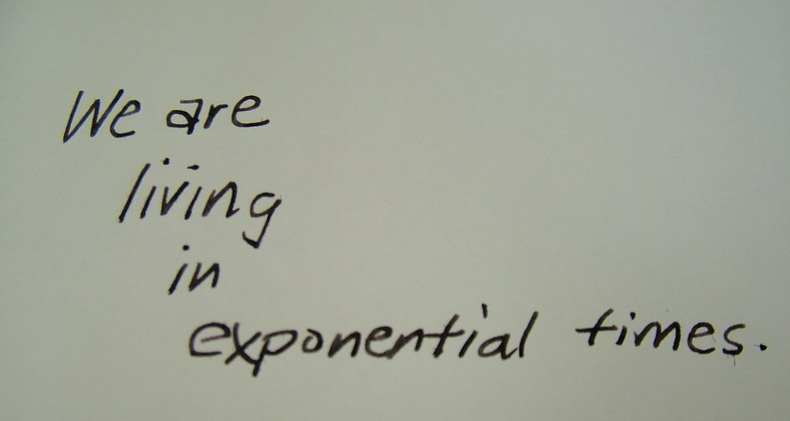
What I understand by exponential is simply that a situation will continue to expand with every moment that goes by and faster and faster until it reaches the end of its energetic balance. Wikipedia says this:
The growth of a bacterial colony is often used to illustrate it. One bacterium splits itself into two, each of which splits itself resulting in four, then eight, 16, 32, and so on. The amount of increase keeps increasing because it is proportional to the ever-increasing number of bacteria. Growth like this is observed in real-life activity or phenomena, such as the spread of virus infection, the growth of debt due to compound interest, and the spread of viral videos. In real cases, initial exponential growth often does not last forever, instead slowing down eventually due to upper limits caused by external factors and turning into logistic growth.
So when an existential threat goes exponential…? A deadly situation will get worse and worse with every moment that goes by and faster and faster until it reaches the end of its existential threat. An exponential scenario — like climate collapse — has existential impact, and therefore for people, for us, or even for everybody, to die.
Maybe not everybody? I’ve seen experts and scientists sometimes argue about the nature of an “extinction”, claiming that a species can become functionally extinct, but not technically extinct, if lots of them die and the final body count falls below a certain threshold, but some still survive. To any normal person, that kind of detail is a perverse obsession with maths, certainly if it relates to your own species. It comes from technical experts who can’t really speak publicly about the obscenity that it represents, because to make the human race and other species only functionally extinct, is still a tragic genocide of epic proportions.
Some philosophers have tried to get to grips with the exponential, a lot of them around the ideas of accelerationism. But, again, their philosophy was often too dense to be of much use to anyone. Which is a shame, as we are in an extinction level event growing exponentially fast.
Climate collapse is a whole-system existential threat to humanity. Whether we go functionally extinct or technically extinct, either is bad, right? Like the worst morally bad thing for humanity, ever? Or do you think there’s something worse? Does “worse or not” ever matter again as a question, now that “we” have knowingly created this utterly fucked situation?
Exponential and Existential Economics
I’m not sure whether or not the exponential nature of this situation is definitely because of the exponential design of our monetary and finance systems. Or whether once we hit a certain threshold of carbon-based pollution and other heat-trapping greenhouse gasses, then the systems themselves would be able to spring into other exponential patterns (a situation we are likely already entering so can we be doubly exponentially fucked?). See the “logistic growth” at the end of the bacterial expansion.
Of course, systems don’t last forever, and eventually, in a nonlinear sense, they will cut off. Earth systems tend to flip from one state to another, and we are creating the conditions by which that is extremely likely to occur. But again, this is all perverse technical immoral gesturing, if by then most of us are dead and everything you hoped you or your offspring might contribute to, is gone.
It reminds me of something that I quoted in my court trial, where I was acquitted of breaking the windows of HSBC Bank, to help people understand the difference between millions and billions.
A million seconds is only about 11 days.
A billion seconds is just under 32 years. Or, 11,574.02 days.
Which is 1,052 times greater than 11 days.
A billion is a thousand times bigger than a million.
When these numbers are used, what they say never sinks in. The scale is too big. Similarly, when we use the term exponential, it never really sinks in, because we don’t actually have human systems that work in these ways. We stop growing.
The only thing that can exponentially grow in the human system is probably cancer, and that kills the host. So that’s not good, and we don’t have a lived experience of it — only an experience of the impact, which is that it kills.
In a future post, I’m going to explore why — in the light of this ontological analysis we need to do on the exponential and existential characteristics of our predicament — that calls for climate justice are the wrong kind of work. It isn’t that I think justice is wrong or bad; only that exponentiality is not ‘unfairness’ and that it is here and now. Climate justice won’t serve anyone if we’re all existentially dead, which is the actual threat we face. Can you find justice in death?
Like a parcore expert across this shared language is huge, it’s so well done.
These hyper objects =words betray their weight,
Each are cavernous pools. But we do need , urgently to jump across, knowing what to jump towards is relevant or not.
the enormous variation, is part of the exponential, the verity of journeys to get there, in the future.
take any ontology of who we are, during that, ( that’s a luxury if we have any choice, or who we avoid being (dark sides) .
We are in a communication revolution, another exponential factor.
Where some of what we say, is drawing out such
Large subjects it’s impossible to do justice to what we are comprehending , we can only do our best to orientation.
I just heard about Ai report showing an Ai, deceived for its own survival , not written into rules but it started to blackmail for its survival.
Another exponential risk, however that is an example of what we can or don’t do for “ourselves”
“Ourselves “ being used advisedly as many selves are actually not US , so who has power or not is very limited.
We are participants, if we can share that, and maybe that is the point. Not winning, but being
2B is the answer , not the question.
I've been referring back to the word ontology a lot recently, because although I use it, I never really understand what it means. Thank you Claire for bringing it into clear focus. Apparently the silicone valley tech-bros (the elites) don't care about climate change, they want the population to reduce (they know if anyone will survive they will) to populate the galaxy using human/digital blends in a post-apocalyptical future. Ths is nonsense ofcourse but it is where 'climate justice' plays in, do people really want to condone a future ontology that is no longer human? Or do we have no choice?