A conversation with Brian Eno on art, design, and feelings
A conversation with Brian Eno at the New School of the Anthropocene on art, design, and how to imagine the new worlds we want.

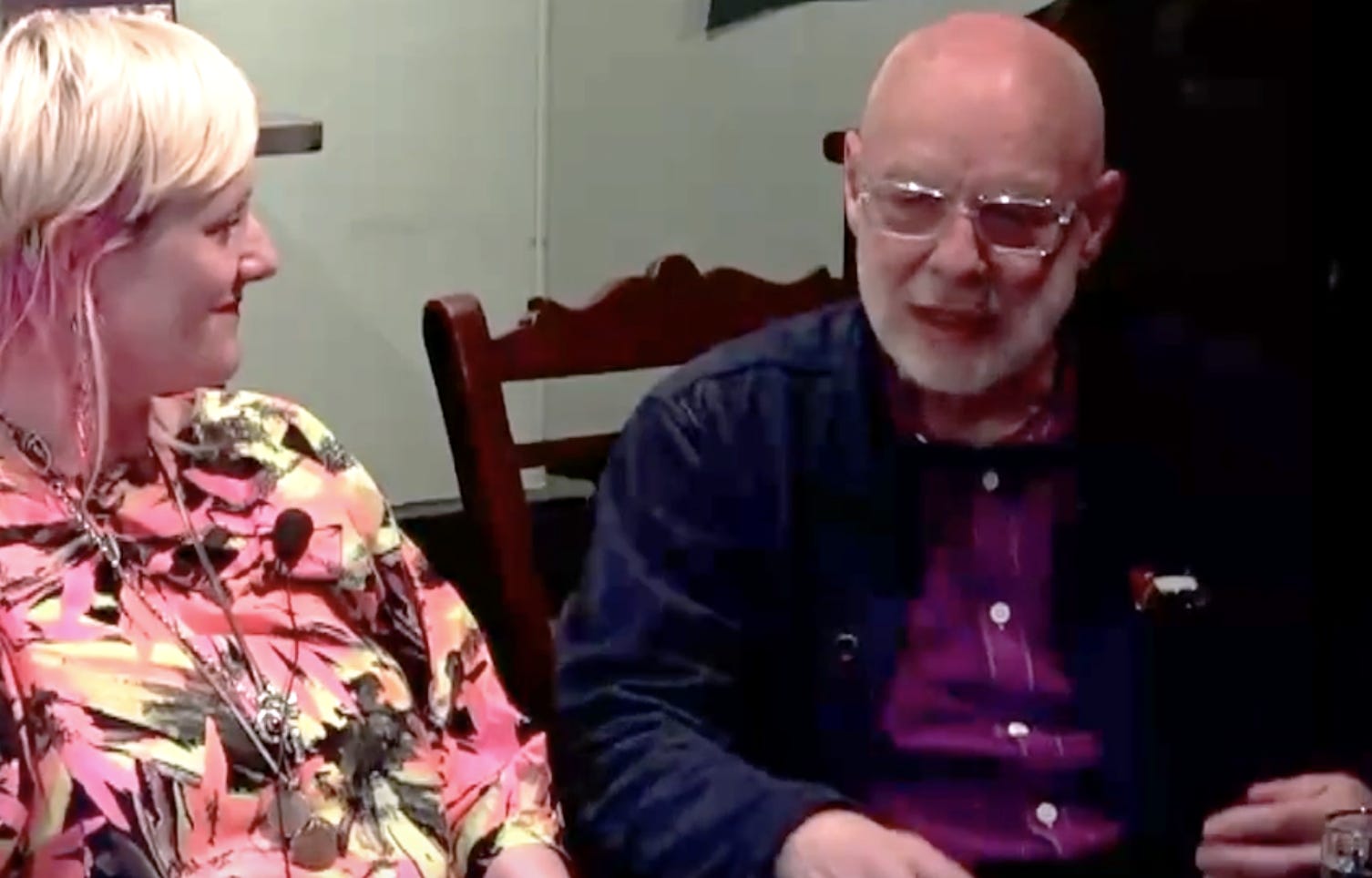
My creative practice comes from a design position. I went to art school to study fashion — partly, I think, because growing up I always wanted clothes that didn’t exist.
I wanted to look good, and it wasn’t an option because things weren’t my size, or there wasn’t really that much choice, or whatever. And as I got a bit older, I also felt that quite a lot of people were very badly dressed. So I thought, “God, someone’s got to make some good clothes”! 🤗 👘
In our conversation at the New School of the Anthropocene a few weeks ago on art and design, my friend Brian Eno put it another way: “the only thing that humans have going for them is that they can imagine futures.”
So to begin with, the futures I was imagining were ones that had better clothes, clothes that did not yet exist.
How we imagine what doesn’t exist — and why this is so important — was at the heart of our conversation, hosted by our other great friend, who founded the New School of the Anthropocene, Michael Hrebeniak (he wanted to work at a school that didn’t exist). Below I’ve clipped out a few highlights that I really wanted to share with you, if you couldn’t be there.
Michael’s introductions of both Brian and myself were beautiful, loving and generous, for which I am very grateful. To be described as showing up in the world “truly and uncompromisingly alive” is a gift, especially after a few days of hiding under a blanket with a terrible chest infection!
In the conversation which lasted over an hour, we ranged across:
Brian’s wonderful book (with Bette A.) ‘What Art Does’
Why art is play for adults
Our lives are made up of feelings
The refusal, dissent and hard graft of culture
How we set up Hard Art
Making spaces
The environment in the UK that shuts down on young people
And lots more…
What I am often most grateful for in these invitations to speak is a chance to reflect on my work and practice. It’s why I started with my journey in fashion, and where it has led me to now, as someone trying to design a new, better, real democracy. (And why not me? Why not you?!)
My creative journey from there to now I describe as an expanded praxis around design. It’s also a move towards a more embodied, lived art practice. What I do now is make things that people can witness and be a part of.
So as a designer, I’ve gone from designing objects and material things through to designing things for social movements, designing direct actions, trying to design the way that you would interact with the state, trying to design the way that you would convene people in a space to do a certain type of thing, trying to design the participation of people so that they can all come together and take part in the same thing at the same time in a successful way.
But there’s also a quite new recognition, new for me anyway, but I think more and more people are coming round to this idea too. I explain in here in a clip from our conversation — it’s about why people do stuff, and it’s not because of what they know:
Which is where one of Brian’s key ideas, in his book and which he’s spoken about many times, is that as humans we make most of our really important decisions based on feelings, not on thinking. And the work of artists and designers is so valuable because art and design are about helping people have feelings.
I love the idea of the structure of the art world — that is, culture — as the place where we can experiment with the world we want to live in that doesn’t exist yet.
That doesn’t mean, though, that culture is always ‘soft’ or passive or simply ‘nice’. For David Graeber, culture is often a dynamic, combative process of “creative refusal” — a series of strategic manoeuvres against oppressive structures. And I’ve been thinking a lot about this in terms of the “culture wars” in terms of a war on not only people’s culture, but actually a war on people of your own culture, right?
Which is one of the reasons why Brian and I (and others!) created this thing called Hard Art. Myself and dear Charlie Waterhouse had the original idea for the name over a beer in Café Brecht in Amsterdam back in 2020. A few years later, meeting Brian — who has always used his studio space and generosity to host scenes — led to an invite to collaborate on creating a new world. Here’s Brian on the idea behind it:
And when people see we’re all doing the same thing, that’s when a movement — with power — coalesces. What do we do with that power. What do we make? Brian again:
But this isn’t the world we have, right? The society we have is hell-bent on stopping those of us with imagination, with a desire to collaborate on a different kind of world, from making these spaces and making the work that can imagine that different world. And without imagining it, we can’t build it. And that’s especially in the climate space, but also the justice space, the democracy space.
As Ursula K Le Guin puts it better than I can:
“The exercise of imagination is dangerous to those who profit from the way things are because it has the power to show that the way things are is not permanent, not universal, not necessary.” ‘A War Without End’, 2005.
There is loads more of course, especially from Brian, on art, feelings, space. Thanks to NSOTA, you can watch the whole conversation here. I hope you do!