"We must recognise each other"
A Constructive Programme interview with Rabbi Jeff Newman

A little over six years ago in October 2019, a then-77-year-old rabbi with an extinction symbol on his kippah was arrested for kneeling and praying in the road and refusing to move, during a protest as part of the international rebellion against climate collapse.
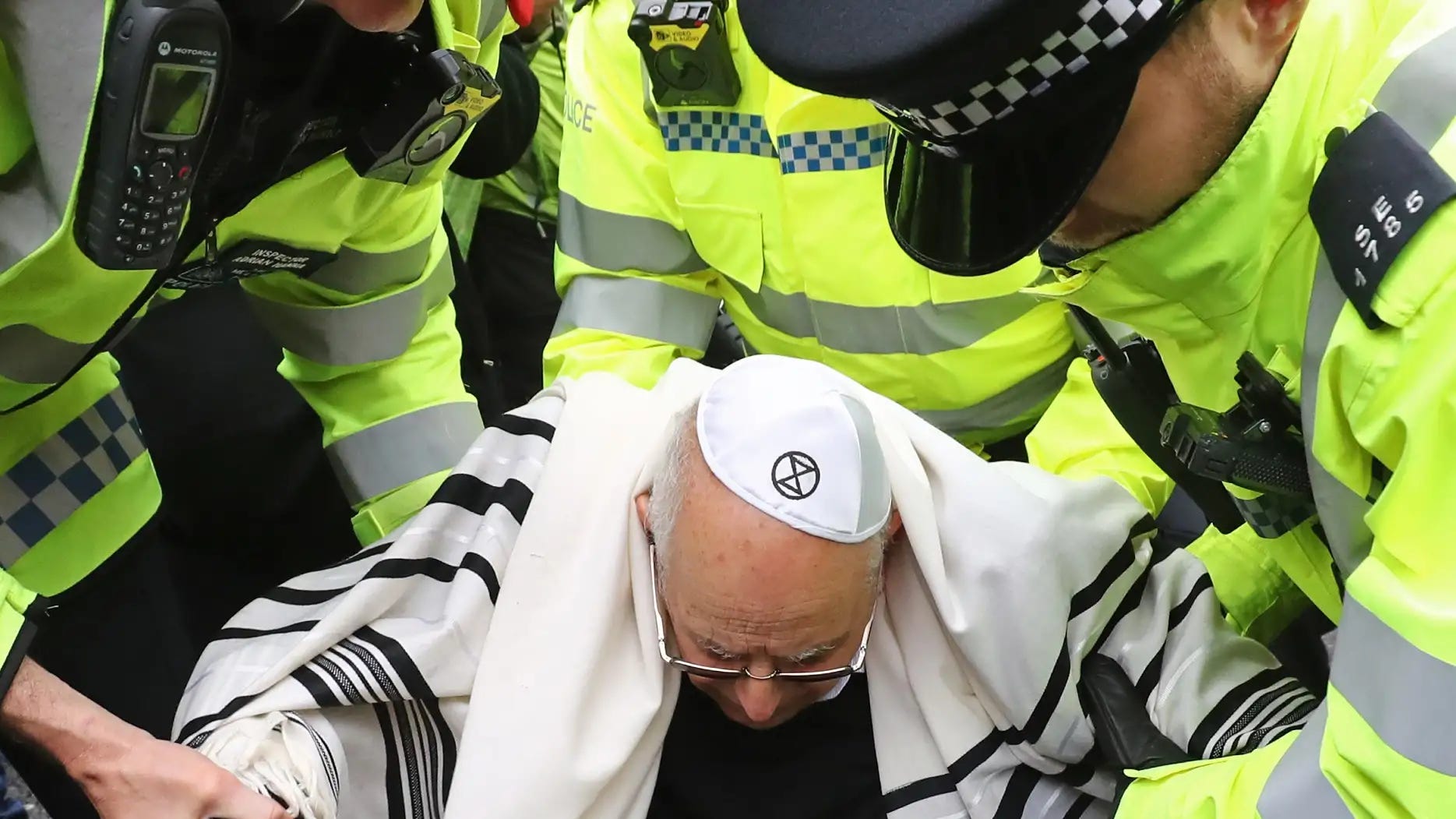
Rabbi Jeff Newman, the Rabbi Emeritus of Finchley Reform Synagogue, had earlier that morning led around 30 fellow protesters from Extinction Rebellion Jews in a shacharit morning service. Rabbi Jeff, as he’s known to me and many others, had already been a long-time environmental campaigner when he was arrested, in what people believe is the first time in the UK a rabbi has been arrested for nonviolent direct action.
So, as I am grounding myself in the profoundly spiritual practice of figuring out a constructive programme for the UK — what is it we must do, practically? — I knew I wanted to speak to Rabbi Jeff again, to see how his journey had unfolded over the last few years, as well as to ask for guidance and support on my own journey.
As I said recently when I was privileged to sit down and talk with James Hansen, the world’s most well-known climate scientist, figuring out how to construct a new democracy able to cope with, or even just to survive the multifaceted intersecting shitshow, is my life’s work. (I’ll write more on my time with Hansen soon.)
And if it is a life’s work, then it is a vocation. A vocation requires spiritual guidance, ritual, learning, compassion, and wisdom. It’s the elders I’ve met in the last decade who I have turned to first, and who have been generous enough to let me share those moments in our conversation that have most moved or inspired me.
Material, symbolic… synchronistic
A few months ago I sat down with Rabbi Jeff to ask him about how to do this work of constructing a new programme for the UK, and how to ensure the work is recognised as both practical and spiritual. What, for example, is the right balance or focus of the material and symbolic in the work that needs to be done — something we were always working at in Extinction Rebellion, and remains a question for me, and maybe the work of all those who are trying to build something new.
I don’t believe a new democratic system can be all symbol, or all material. But what’s the right balance? As Rabbi Jeff told me, perhaps it is not about balance at all, but the right combination to make a breakthrough.
As Rabbi Jeff asks, a key question in this is how do we recognise one another — so that we can be kind and dignified with one another, rather than fearful and violent — when the systems of power around us are rigged to do everything they can to have us not recognise one another as interdependent beings? As kin? When those who benefit most from those rigged ratchet systems of power use them to keep hold of their wealth and control? (Rabbi Jeff did not wait to exit Twitter after Musk bought it; he left quickly with principle and has not returned.)
What is a democracy, anyway?
At the end of last year I convened a series of online round-tables — The Assembly Dialogues — on the subject of people’s and citizens’ assemblies as a form of democratic participation. One of the learnings that I took from this, and from simply watching the world’s political systems fail in a state of pre-collapse, is that we don’t have a democracy as it is. And perhaps we never have. Most of us don’t even know what a democracy would actually feel like.
At the same time I’ve been reading as much as I can on the thought of democracy, especially from people such as Hannah Arendt, who is also one of Rabbi Jeff’s guides in his work on thinking through all the difficult questions including Judaism, Israel, Palestine, climate and power.
One of the thoughts I put to Jeff, as we discussed assemblies, was that a failure of their practice at the moment, even as both citizens’ assemblies and other forms of participatory democracy have ‘a moment’ and are giving people real hope that a different way to govern ourselves is possible, is that so many assemblies come to great outcomes, but don’t change anything. What’s the point of them at all, if the decisions people make don’t lead to material changes?
Here’s Rabbi Jeff, on Hannah Arendt and the decision:
The question of really hearing
I’ve thought a lot about this myself — particularly as I’ve helped articulate elsewhere, in Humanity Project that I co-convene with Nick Gardham from Community Organisers and the Black community leader Lee Jasper (subscribe to his substack for essential reading, most recently on Jamaica and Hurricane Melissa). Humanity Project is all about bringing people together, not to promote free speech, but the right to be listened to, to help us gather and, as Rabbi Jeff says, recognise difference.
And what Rabbi Jeff also says: listening is spiritual practice.
Climate, community… assembly
At the end of our conversation we turned back to where Rabbi Jeff and I first met — in the early days of Extinction Rebellion’s protests and direct action. I actually think I first met Jeff because he was at a meeting at our offices and I helped him do something on his I-Pad that he was stuck with! We are both certain that the catastrophic imbalances in our earth energy systems will lead to overwhelming social system ruptures: a lot of people call it collapse, my friend Jem has a decent glossary of terms.
And if we know that this is going to happen, what are the most important, practical, life-affirming things we can do?
It comes back to the practices of how we can make space to recognise each other. Build community. Organise assemblies.
As Rabbi Jeff said in the past (in one of his last ever Twitter posts!): “hope arises from action.” And what he meant was: not the other way around. We know that action drives belief. We know action drives mood. Taking action — doing something — is the way to shift what we think is possible. You can’t give other people hope, you must cultivate it yourself and help others to do the same!
And so, if we want to think that another kind of democracy is possible — a real democracy after all! — well, we can’t just hope for it. We have to take action. We have to construct it. Material change, with symbolic power, enough to rupture the existing status quo shitshow.
So let’s act.
Clare, there’s so much to take from your conversation here. I am struck by what Rabbi Jeff says about assemblies and decision - “maybe it’s about voicing and hearing others, and recognising differences.” That is no small transformation, one I’ve witnessed first hand in the work of Humanity Project. As you reflect in the title of this post, we must recognise each other to build anew as systems collapse. Thank you for these conversations.