Termination Shock: The Faustian Bargain with our Lives
This is Part 2 of when I met James Hansen, one of the most important living climate scientists. In this post I dive further into the here and now of termination shock.

A termination shock is what happens when you suddenly stop something, and that stopping — the termination of what you were doing — leads to a shock to the system. The shock could be a complete surprise, but it could also be an impact people knew about but thought was a side-effect worth suffering.
I wrote in the last post that termination shock is an issue that has been raised in relation to Solar Radiation Management or geo-engineering more generally. That is: if you stop doing the geo-engineering suddenly you will very quickly feel the bounce-back of the energy accumulating in the earth system, and therefore a very rapid onset of heating. That’s because these interventions only mask warming rather than remove the underlying greenhouse gases, and so the cooling effect is at best fragile and temporary — and once the intervention stops, any masking impact rapidly disappears.
When I met James Hansen in Helsinki, I was keen to ask Jim whether or not he believed we were living through a form of termination shock right now?
I believe we are. And to the people who caused it, it wasn’t actually a shock at all; they knew.
The Shipping Emissions Forecast
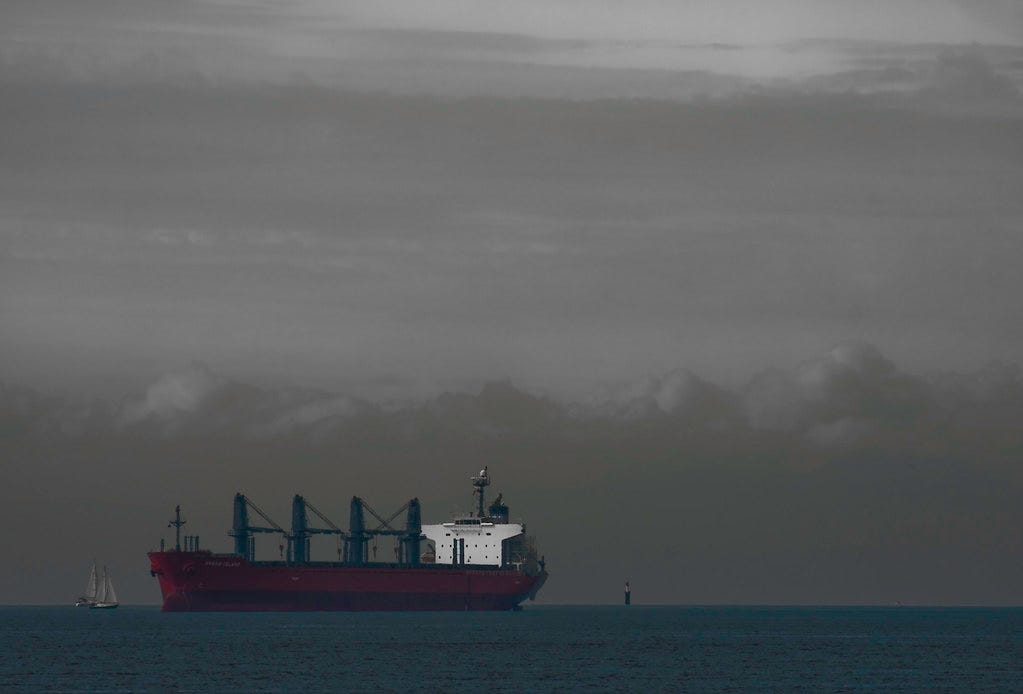
We are most likely already living through a kind of termination shock: the removal of 80% of the sulfur content from maritime shipping emissions, and its immediate rebound impact on global heating (and ocean heating). A paper on that was released in 2023.
What happened was this: Up until 2020, global shipping used high-sulfur fuels that produced a huge amount of air pollution. Those pollution particles blocked sunlight and helped form more clouds. This actually put a block on the global heating caused by fossil fuels. But the International Maritime Organisation (IMO) introduced new regulations that removed the sulfur content of shipping fuels, by over 80%.
Dr Tianle Yuan at the University of Maryland in the United States led the 2023 study, and calculated that the drop in pollution particles significantly increased the amount of heat being trapped at the Earth’s surface. They estimated 0.2 watts per sq metre of additional heat trapped over the oceans after the pollution cut was “a big shock to the system”.
Shocked, surprised, or screaming?
So, were all the headlines — last year, for example, on the BBC News website saying scientists were “gobsmacked” or “dumbfounded” about how the rapid increase in warming could have possibly come about, particularly during a La Nina year — a false representation?
As far as I could tell, simply from reading the science, it wasn’t that scientists were shocked: it was that some scientists were screaming from the rooftops that they knew about one thing that contributed to this rapid increase in warming, but nobody was listening. That thing was a single policy decision.
The actual Faustian Bargain
In my last post, I mentioned that I felt one of the most useful contributions from James Hansen has been his encouragement for us to understand the nature of our predicament as arising from a Faustian bargain.
A Faustian bargain is a deal that you do with the devil. It means you’ve traded away something of moral or spiritual value—like your soul, or integrity—for a worldly and short-term benefit, such as power or wealth. It comes from the myth of Faust and Mephistopheles. It’s also an important part of Christian teaching and tradition.
For all of the communications that we make about the climate crisis; our deliberation about whether or not we need a hero and villain story; whether we need to call for collective emancipation, compassion, acceptance, or humility, or justice; Jim’s focus on the Faustian bargain stands out because it recognises that a deal has been consciously made, by individuals.
Jim’s suggestion that we think about the climate crisis as a Faustian bargain is useful, because it says: someone knew, and they made a deal with the devil to sell their morality for short-term wealth.
Who made the Faustian deal?
It is contentious to use the word ‘we’ to describe what is happening in terms of our collapsing climate and earth energy systems balance. That’s because, of course, who is the ‘we’ who knew? Who is the ‘we’ who profited? Who is the ‘we’ who decided? And who is the ‘we’ who must act?
But with a Faustian bargain, there are individuals involved. Those individuals understand the nature of the situation and the deal that is being made.
Some knew what they were doing. Most of us never knew it was being made at all.
The case of sulfur emissions
So it’s worth focusing on the example of shipping emissions.
When the International Maritime Organisations (IMO) changed the shipping fuel regulations to remove 80% of sulfur from emissions, they changed very abruptly the levels of sulfur that were being emitted into the atmosphere along all of the major shipping lanes on the oceans.
Jim Hansen and Leon Simons, in their work on the warming in the pipeline, have been quite clear that removing this volume of sulfur very quickly from areas that were being permanently and consistently polluted with it has created an effect: the termination of particulate pollution, which was helping to seed cloud cover, and the cloud cover was helping to keep the ocean cooler. Without this, we’ve seen extreme ocean surface heat increases, and all of the consequences that come with that, including the intersection with the complex dynamics of the oceans where we can see coral bleaching and mass die-off of plant and animal populations. This includes many species that help sequester carbon.
These scientists say this: that the aerosols (particulate pollution) emitted by the burning of fossil fuels are the second most important forcing factor in the earth’s energy system.
A “forcing factor” is any process that alters the balance of energy entering and leaving the Earth system.,
So, how did it come to pass that the aerosols emitted by the burning of fossil fuels were the second most important forcing factor in the earth’s energy system? And who knew, and then covered it up? And how did those people who covered it up watch the unfolding of the IPCC process over 30 years without speaking up and saying “actually we’ve hidden something of great consequence, and we should measure it and understand it, and face up to the fact that this is one of the most important dimensions of this problem, and you are all overlooking it, but we know that it’s there, and here’s the research,” but instead sat by and said nothing?
Who gets to push us over our tipping points?
So, what’s actually happened is that a small group of people – the decision makers at the International Maritime Organisation – have made a decision that massively impacts all of us, and all of the beings being boiled and killed in the sea, like our coral reefs.
Our climate tipping points, then, have been governed in part by this small group of decision-makers in the IMO.
Some people I’ve spoken to believe that the IMO knew there would be this rebound effect of heating from the removal of these aerosols, given that the data has now been made relatively clear (people told us not to talk about it when we launched Extinction Rebellion).
I’m sure that the IMO didn’t have firm data on which to base their estimation about increased warming. However, many people have told me that this issue was definitely known and understood, and so the decision-making process that led to the shipping fuels regulation change will have considered global warming, and whether or not it was worth the trade off to remove the sulfur and suffer the increased heat.
Some of this increased heating is localised. But by combining the cleaning up of pollution in many parts of the world (mostly for the benefit of human health, which is obviously a good thing) we are increasingly taking away the mask that hid a lot of the warming for many years. How much? According to Carbon Brief: “Roughly one‑quarter of the increase in global temperature over the past two decades stems from this unmasking of human-caused heat. Altogether, recent aerosol cuts may have contributed ~0.14C of the ~0.5C of warming the world has experienced since 2007.”
Lovelock’s warning from the 1970s
It was in the 1970s that James Lovelock worked on studies for Shell looking at aerosol particulate pollution and the masking effect that that had. This is how we know that the fossil fuel industry was well aware not only that their product was deadly to the human race, but that the industry hid the fact that ‘we’ (meaning us, this time) wouldn’t notice until very, very much further into the future. This was hidden by the fossil fuel companies on purpose: it ensured decades of profits from a public coerced into ignorance.
If we could feel the full effects of the warming we’ve created, we would already, I’m sure, be willing to shut down the entire fossil fuel industry and take control of the situation, because it would be very apparent that we can’t live on a planet that gets hotter than this.
However, now we’re caught in a trap. Because if we stop the aerosol particulate pollution, the problem gets worse very quickly; and if we continue, it definitely gets worse, and we ‘can’t stop’ forever.
This is the ultimate business trap that I’m sure the fossil fuel industry has reflected on in just as savage a manner as I have just described it. To put it even more succinctly, it’s this:
“Let’s capture people in a way that means they need us, indeed they subsidise us. If they continue to use our products, they’ll die slowly, and if they stop, they may die more quickly, so they’ll just carry on.”
That is, literally, the thought process of the people who made the deal with their devil.
Is there anything more important to think about, right now, than this Faustian bargain these people have made on behalf of the human species — the rest of us? Can we reflect on the situation and perhaps think about whether or not there really is any way out? Or any means of accountability for such a thing?
Not in the future, but now
My friend Laurie Laybourn talks about derailment risk — the risk that the cascading and compounding impacts of the climate crisis (extreme heat, extreme floods, extreme deaths, etc) will derail policy makers from tackling the causes of the crisis.
Laurie often talks about derailment risks as in the future. Often when we talk about these issues, we do talk about them speculatively as things that could happen in the future.
I think we’re in them now.
If we sit and think about the future fear of these termination shocks, how frightening the prospect of that is, then we might act now to stop it. We might consider the dependency we have already created, and the fact that private companies and international bodies, like the IMO, are really governing tipping points as we speak. Our present governance infrastructure is controlling the world’s habitability and most of the power is in corporate hands.
We’re already in that situation?
Isn’t it obvious that we already have a very dangerous dynamic where the entire world’s population is — not could be, but is — being held over a barrel by a small number of corporate interests and a small number of countries?
We are already in a termination shock. So, I think it’s important to situate ourselves in the here and now. We are already feeling the effects of the rapid removal of pollutants which were cooling the earth system, or at least masking the heating.
The here and now
This is so important. Let’s pull ourselves back into the here and now. Let’s face reality. Let’s ask who has made the Faustian bargains on our behalf.
We must ask ourselves: what is happening and how might we govern ourselves through tipping points — and not let a small group of corporate execs decide our future?
That’s what I’ll go into in the next post.
I know someone involved in the policy making relating to this decision when UK was in the EU. I have railed at him about this issue but he explained that the number of immediate deaths (of humans) related to marine pollution was too high to continue in the Mediterranean. It was a political not an ecological decision. I don’t think future human and animals deaths (which will be much higher) were fully unpacked because this can’t be factored in. Political decisions are currently made on a short term basis. This is what we are dealing with and why it all feels impossible.
I find it interesting that Trump's stupid attacks on Iran have closed Hormuz for months and, with that blip of pressure on shipping volumes and Diesel supplies, that has:
Cut international shipping volumes immediately, and so damaged Middle East infrastructure and economies, and generated demand destruction, such that fossil production and shipping is likely to settle at a lower level.
Driven more sales of EV's in Europe, perhaps more than all the other policies of subsidies and discounts, exacerbating fossils demand destruction and undermining the economic and business case for fossil fuel infrastructure.
Rapid change IS possible, provided the incentives are direct and personal enough.